
Steve Maxwell’s Big 6 plus Workout!
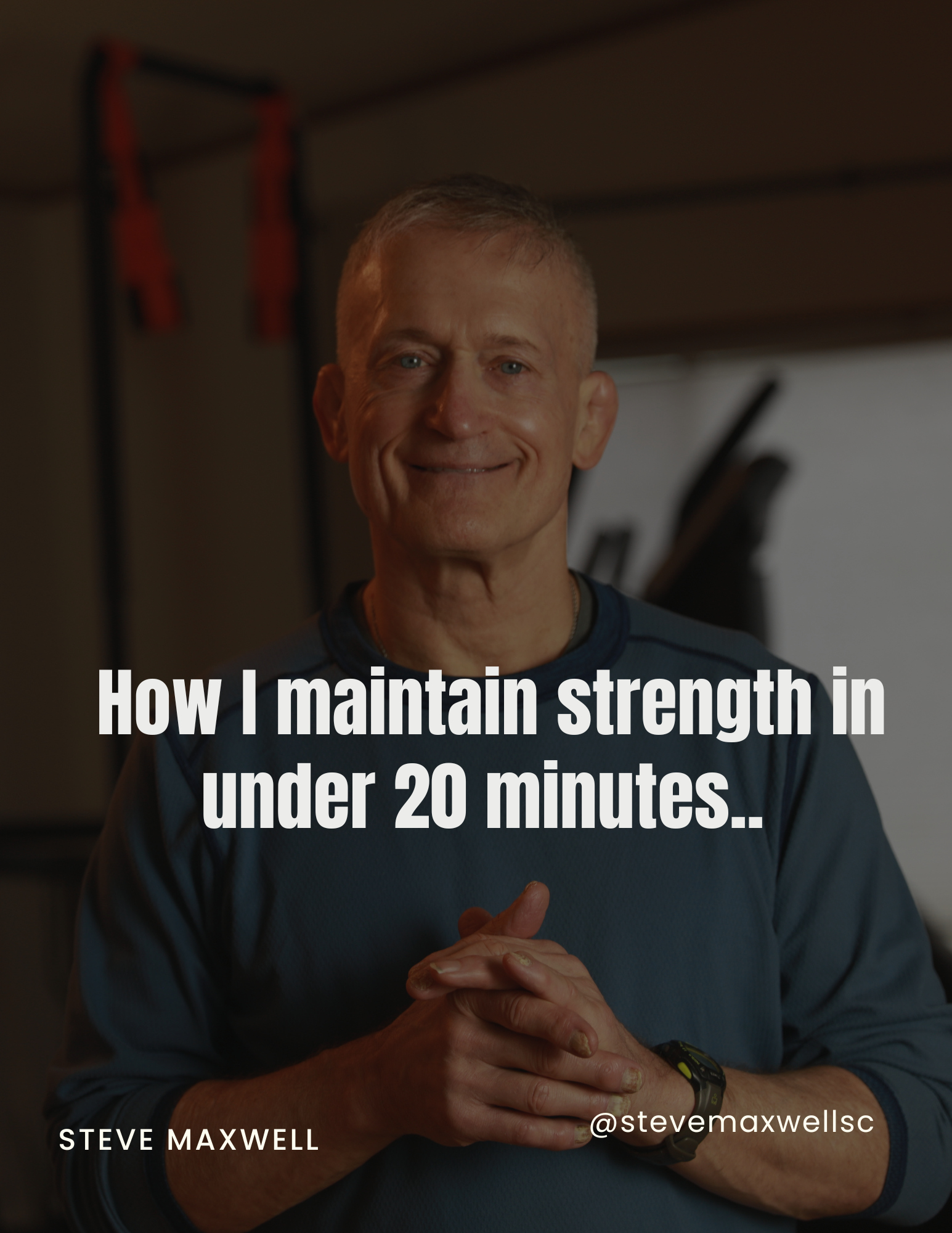
One of the most useful training concepts I’ve used over my training and coaching career is the Big 6, an incredibly efficient strength workout for the time-leveraged.
Principle: workouts do not need to be lengthy, or time-consuming, to be effective BUT they need to be intense
the Big 6 sequence, you can get very strong—or maintain an already high level of strength—in a brief session—I’m talking in under twenty minutes. This is such a boon for busy working parents, or athletes heavily engaged in their particular sport. For me, personally as an active jiujitsu player and former competitor, I frequently lacked the necessary nerve energy for prolonged strength training and this was my base workout then, and even today.
The Big 6 is a movement-based workout consisting of:
an upper body vertical push
an upper body vertical pull
an upper body horizontal push
an upper body horizontal pull
a hip hinge
a squat
This combination hits all major muscle groups of your body.
There exist many variations on this particular workout and I have tried them out over the years, and even now, the Big 6 forms the basis of many of my current workouts.
Caveat: I’m not giving away any particular secrets here; you’ve still got to do the work!
When time and energy resources are available, I have an addendum known as the Big 6 *plus*
The “plus” includes:
calf, foot, and ankle work
front and rear neck work
work for grip and forearms
some abdominal work
I’d like to point out that the abs are worked, hard, in the basic Big 6.
In extreme cases of leveraged time, the Big 6 can be divided into two sessions of the Big 3.
(Dang, now I am giving away my secrets)
An example of a Big 3:
an upper body vertical push
an upper body vertical pull
a hinge
Thus, on a separate day:
an upper body horizontal push
an upper body horizontal pull
a squat
Here is an example workout I gave a very busy working mother:
isometric wall sit/squat
gluteal bridge on the mat (which is essentially a hip hinge)
an overhead shoulder press
isometric pulldown, (using a Maxwell special custom apparatus)
horizontal chest press
horizontal row
She was very “worked out” in a very short period of time, and her baby boy, who comes along, was easy going and content because the workout was over quickly.
There are many variations on this sequence; your imagination, and your rationality, are the only limits.
Another example:
today I was feeling low vital energy, so I commenced a Big 3.
I had just completed my jiujitsu for a lifetime training camp and not yet fully recovered physically. I was overdue for a workout and performed a Big 3:
Fingertip pull-ups on a narrow ledge (something I learned from a rock climber)
Negative-emphasized, slow fingertip pushups
the horse stance—the horse stance, aside from being a superior hip, glute, and thigh workout (when done properly) also very strongly challenges the abdominals, much more than a conventional squat
With these simple workouts, you not only maintain, but you build serious strength.
With most clients, I usually do one hard, all-out set, but, occasionally I do multiple sets, or supersets, as I did today with my own Big 3.
I really like this Big 6 business workout and I consider it a good fit in today’s society. For these reasons, I recommend my immanent video “The Big 6 *plus* wherein you can see these principles put into action.
In this video, I explain the principles and demonstrate the positions, and I’ve also included a follow-along sequence with voiceover prompts to increase your intensity.
Thank you for reading!
In strength & health!
Steve
